|
|
Some worthwhile knowledge and useful informations concerning the artificial eyes and the Ocularist.
|
| The Ocularist | |||
|
What is an Ocularist? He is a specialist, that prepares and adapts artificial
eyes, which
are produced precisely to look like the natural eye. This occurs in a particular and selective
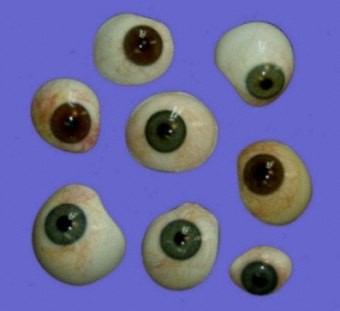
procedure (see also "production"). Very often patients are afraid when they visit the Ocularist for the first time. They think, they have to go through a painful treatment again. Often they are only unsure or they don´t know yet, what will happen to them. We show them what an artificial eye looks like, and explain to them, that the treatment is completely painless. An important point is also to remember, that the most difficult part (If it was an accident, an injury, a malady, a tumor etc. - whatever has led to the loss of the eye) is now past. We try to give them back their natural look and with it connected the return of their self-confidence. |
|||
| Self-confidence - psychological strenghthening to summery | |||
| To become blind is already a traumatic
experience in itself. Often it occurs that one loses this eye completely.
Then these
people wear an artificial eye. A natural appearance is reached again by an individual
adaptation of the artificial eye for each eye socket (Orbita) for the respective
patient.
This fact and also the trouble-free wearing of artificial eyes leads to a certain
appearance and improved self-esteem again. Therefore artificial eyes are not only used for the protection of the socket against impurities and irritations but it is a quite important factor to the psychological care of the patients. If an artificial eye is more or less noticeable, depends mainly (in most cases) on the reason for the loss of the eye (injury, accident, tumor) and the associated operation. If all the ocular muscles still exist, the Ocularist can prepare an artificial eye so that it is not felt as an "artificial" but much more like the "own" eye and it will not be noticed at all. |
|||
| Forms | |||
| Artificial eyes are roughly subdivided in two
categories - into the "double-sided" and into the "single-sided"
design. The "double-sided" is thicker and stronger than the "single-sided". Therefore, it is rather used at larger or deeper eye sockets. If the socket should have become atrophied, an "single-sided" form is prepared with considerable probability. If there is still the existing eyeball without vision or if the Bulb is already shrunk, one carries a very thin prosthesis, a so-called Skleral- or Bulb-shell. The designs of all prostheses always differ amongst themselves, because each artificial eye is specifically and individually prepared for the eye socket of each patient. |
|||
| Material selection to summery | |||
| By the selection of material, there
are some
essential advantages for the special-glass (Kryolith) instead of the acrylic
material (PMMA). These advantages have been proven by scientific tests, and
for many generations many wearer of
prostheses have shown a preference for the special-glass artificial eye (see also "material comparison").
These advantages are:
|
|
||
| Implants | |||
| When the eyeball is removed, the volume or this
space,
which was occupied by it, can be filled. So-called implants fill this task. Implant exists
in different materials and in different sizes. The doctor that is treating
the patient will decide which implant is the best suited for his patient. The implant serves only as eyeball substitute, that fills the space which was emptied by the removal (Enucleation) of the eyeball. Later, the artificial eye is carried on the implant, similar like a contact-lens on the sighted eye. That the artificial eye moves, is the activity of the ocular and lid muscles. |
|||
| Mobility of the artificial eye to summery | |||
| From long experience one can say that in
accordance with the prerequisites of the socket and the still sufficient existence of the
ocular musculature a very good mobility of the artificial eye can be reached. |
|||
| Start of the treatment | |||
| Approximately 2 weeks after the
operation, the
patient should visit the Ocularist according in agreement with the treating
doctor
the further procedure is decided between Ocularist and patient. By no means should the time period be too long because this could lead to a change of the eye socket and the lid border folds. This could have influence on the natural look of the prosthesis. |
|||
| Difficulties after the removal of an eye to summery | |||
| After the removal of an eye one can
only see two-dimensional more. The depth perception is lost. The depth perception is the
ability
to appraise the size of objects and her distance. With two healty eyes, an object is normally viewed from two negligibly different
visual angles. Consequently, one sees three-dimensional. If there is only one eye left, the second angle is missing and consequently one sees only two-dimensional more. At the beginning this leads to small problem, but after a short period of (getting accustom to the situation) time our brain helps us to make an assessment of distances again. Therfore the three-dimensional viewing can be learned. It is very helpful to move the head or the whole body, a litte back and forwards, in order to see things at different angles. By doing this, one can get a sense of depth perception again. Surely, a period of time and patience is necessery because in the beginning it can be rather frustrating if one grabs for things, but grabs "beside" it. By such situations, it can be helpful to use some tricks as to touch the end of the glass with the bottle when pouring, for example. Basically, one can say that the loss of an eye leads to no insurmountable handicap. Patients can (with a short adjustment time) do nearly everything that they had done previously with the use of an artificial eye. |
|||
| Copyright © by Schreiner-institute for artificial eyes |